Why Development Plans Use More Than One Horizon
Why development plans use more than one horizon, and how to distinguish authorized tasks, preparation, and long-term aims when reading a public plan.
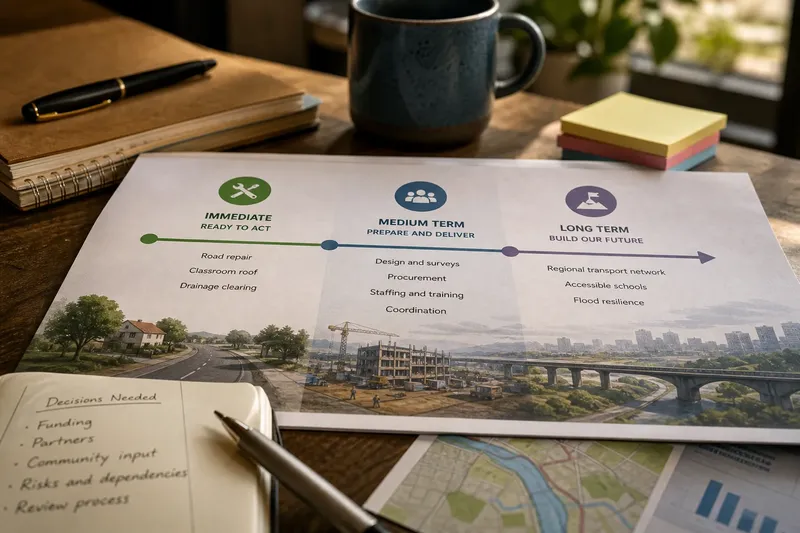
A road repair can be authorized for the next budget cycle, while a regional transport network depends on choices that may extend beyond it. Development plans use more than one horizon to distinguish immediate work from preparation and longer-term aims. The distinction helps readers see which actions are ready for a decision and which depend on later choices.
A planning horizon is the period a plan uses to organize intended action or change. It does not, by itself, promise that a project will finish on a particular date. A useful plan makes clear whether a date marks an authorized task, a review point, or an intended direction.
Different clocks
An immediate horizon can identify tasks an institution is prepared to begin. A medium horizon can make the work between an announcement and a service visible, such as design, staffing, procurement, or coordination. A longer horizon can express a direction that depends on repeated decisions.
A bounded task and a broad aim are not interchangeable. Repairing a damaged classroom roof is a defined activity. Making schools accessible across a district involves multiple buildings, budgets, staff, and local decisions. If a plan gives both the same confident wording, readers may mistake an aspiration for a scheduled commitment.
Check what each date means before judging it. A deadline, a review date, and a target date carry different implications.
Planning across time
Development plans often address decisions that do not fit neatly into one budget cycle. A public body may be able to authorize a discrete activity through a current budget, while a larger effort can depend on later funding, approvals, staffing, or coordination with other institutions. Which arrangements apply depends on the plan and the institutions involved; there is no single history or model that explains every planning system.
A long-range plan can connect projects to wider aims, such as linking transport decisions with access to markets or public services. It cannot replace the decisions needed to authorize spending, assign responsibility, or respond to changed conditions. Readers should look for those links rather than assume that a longer timeline supplies them.
Political priorities, economic conditions, and institutional capacity can change. A plan that describes a fixed future without explaining how it can be reviewed may become difficult to use when assumptions shift. Multiple horizons can help distinguish work that is ready to proceed from aims that require later choices, but the labels alone do not make a plan adaptable.
Match time to purpose
Read a plan according to the decision you want to understand. Use these checks to identify what its timeline supports:
- Named task: Check whether the plan identifies an activity and its scope. If both are clear, treat it as a defined piece of work; if either is vague, look for a more specific description before treating it as ready to act on.
- Responsible body: Check whether an agency or partner owns the next action. If one is named, assess that body’s stated role; if none is named, ask who is expected to act rather than assuming responsibility.
- Authorization: Check whether the plan points to an approval or budget decision. If it does, distinguish the authorized action from broader aims; if it does not, read the action as proposed or unresolved until the plan clarifies its status.
- Preparation: Check for design, staffing, procurement, or coordination that must happen first. If those tasks are described, use them to understand the sequence; if they are absent, ask what must be resolved before delivery can begin.
- Dependencies: Check whether later work relies on other projects, agencies, or community decisions. If dependencies are stated, read the timeline as conditional on them; if they are not, seek clarification before treating the later phase as settled.
- Review process: Check when and how assumptions can be reconsidered. If the plan specifies a review, use it to identify when changes may be considered; if no review is described, ask which institution can revisit the plan as needs or conditions shift.
- Community input: Check how affected residents can inform decisions. If a process is described, assess whether it applies to the relevant phase; if not, ask how local priorities will enter later decisions.
A near-term task needs a clear scope and owner. A long-range aim needs an intelligible path for future decisions. Neither label establishes whether the plan is well designed.
Commitments and aims
A commitment describes an action an institution has agreed to pursue, often with a responsible body and a decision process. An aim describes a desired condition. The distinction can blur when a plan uses confident verbs but does not state who must act or what would count as progress.
“Begin improvements to neighborhood drainage” suggests an activity, but readers still need to know where, who is responsible, and how it is authorized. “Ensure every neighborhood is protected from flooding” describes a much broader outcome that may depend on multiple projects and conditions beyond one agency’s control. An official document’s wording does not, by itself, turn either statement into a secured result.
Look for a connection between present tasks and later aims. If a plan explains what each phase contributes and which decisions follow, readers can trace its logic. If that link is missing, the document may be listing activities and aspirations without explaining a route between them.
Read time language
Dates and verbs signal different kinds of claims. “Will begin” can express intended action, but the surrounding text should identify authority and responsibility. “By the end of the plan period” marks a target date. “Over time” leaves the schedule open, while “work toward” generally describes direction rather than a specific deliverable.
These distinctions help separate a schedule from a forecast. A schedule organizes intended work; a forecast makes a claim about what is likely to happen. A development plan may contain both, so check which kind of statement you are reading.
Which horizon fits?
What fits an urgent local need?
Start with the immediate horizon and look for actions and responsibilities tied to the current issue. Then check how those actions connect to later work, so you can tell whether the plan describes a continuing path or only a short-term response.
What fits a service that needs preparation?
A medium horizon can make design, staffing, coordination, or approvals visible. Check whether the plan names these tasks and the decisions they depend on; without that detail, the timeline may not explain what stands between an announcement and an operating service.
What fits a lasting community change?
Use the long horizon to understand the intended direction and its stated conditions. Treat it as a guide to future choices, not as evidence that a complex outcome is secured.
What if the plan gives no review point?
Ask which institution can reconsider the timeline when conditions change. Without a visible review process, readers cannot tell how later decisions will respond to shifting needs or assumptions.
Trace the choices
Imagine a county plan with three hypothetical elements: a near-term task to map gaps in rural bus service, a later phase to coordinate routes with neighboring towns, and a long-term aim of improving access to clinics and schools. These are invented planning details, not reported facts. The map could give officials a clearer account of service gaps; route coordination would still depend on decisions by the county and neighboring towns; improved access would remain an intended outcome rather than an established result.
To read the sequence, first identify who is assigned to make the map and whether that task is authorized. Next, check whether the plan names the local partners and decisions needed for route coordination. Finally, ask what later choices would connect those routes to access goals. If the plan specifies those links, the reader can trace its proposed path; if it does not, the gap is a question for the responsible institutions, not evidence that the outcome will follow.
When reading development plans that use more than one horizon, match each time frame to the decision it describes, then check what must happen before the next decision. That keeps immediate duties distinct from longer aims and makes missing responsibility or review arrangements easier to spot.